PCP vs HP: what's the difference and which is right for me?

Written by
Joe Towner
Reviewed by
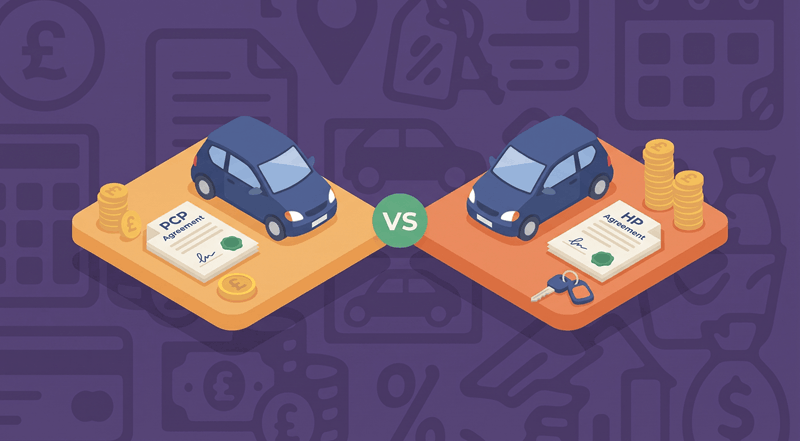
Amy LancashireThe main difference between PCP and HP is ownership. With hire purchase (HP), your monthly payments cover the full price of the car, so once you've paid, the car is yours. With Personal Contract Purchase (PCP), your payments only cover the value the car loses over the term (depreciation), so the monthly cost is lower, but you either pay a large final payment to own it or hand it back at the end.
That single difference shapes everything else: how much you pay each month, whether there's a mileage limit, and what you're left with at the end. Here's how the two compare, what each costs, and how to work out which suits you.
PCP vs HP: the key differences at a glance
Feature | Hire purchase (HP) | Personal Contract Purchase (PCP) |
|---|---|---|
Who owns the car during the deal | The lender | The lender |
Monthly payments | Higher (cover the full price) | Lower (cover depreciation only) |
Deposit | Usually around 10% | Usually around 10% |
Large final payment | None, just a small option-to-purchase fee | Optional balloon payment to keep the car |
Ownership at the end | Automatic, once you've paid | Only if you pay the balloon payment |
Mileage limits | None | Yes, with charges for going over |
Condition charges | None | Yes, if you hand it back with more than fair wear and tear |
Best suited to | Owning the car and keeping it long-term | Lower monthly payments and changing car often |
How does hire purchase (HP) work?
Hire purchase is the more straightforward of the two. You pay a deposit, usually around 10% of the car's price, then make fixed monthly payments that cover the rest of the price plus interest. Terms typically run from 1 to 5 years.
Because your payments chip away at the full value of the car, there's no large payment left at the end. Once you've made the final monthly payment and a small option-to-purchase fee, ownership passes to you. That fee is usually small, often around £100, though it varies by lender, according to MoneyHelper.
During the agreement the lender legally owns the car, in the same way as a secured loan tied to the vehicle. There are no mileage limits and no condition charges, because the car is on its way to becoming yours.
How does PCP work?
PCP keeps monthly payments lower by only financing the car's depreciation, not its full price. You pay a deposit, then monthly payments covering the value the car is expected to lose over the term, plus interest. At the start, the lender sets a Guaranteed Minimum Future Value (GMFV), which is what the car is predicted to be worth at the end. That figure becomes an optional final payment, often called the balloon payment.
At the end you have three choices: pay the balloon payment to keep the car, hand it back with nothing more to pay (within the mileage and condition terms), or part-exchange any equity towards your next car. For a full breakdown, see our guide on what PCP is and how it works.
The key differences
These are the points worth understanding properly before you choose:
Monthly payments, and why PCP is lower
PCP almost always has a lower monthly payment than HP for the same car, deposit and term. That's because HP spreads the full price across your payments, while PCP only spreads the depreciation and defers the rest into the balloon payment. The gap can be significant, which is often why PCP looks more affordable month to month.
Owning the car and what happens at the end
With HP, ownership is automatic once you've finished all payments. With PCP, you only own the car if you pay the balloon payment, and that's a large lump sum you need to plan for. If you don't want to pay it, you hand the car back or trade it in, and you walk away owning nothing. If your goal is to end up owning the car, HP gets you there without a final hurdle.
Mileage and condition
HP has no mileage limits and no condition charges, because the car becomes yours. PCP sets an annual mileage limit, and going over it means an excess mileage charge, usually worked out as pence per mile. If you hand the car back, it also needs to be within the BVRLA fair wear and tear standard, or you may face charges for damage. High-mileage drivers often find HP simpler for this reason.
Total cost to own
If you take PCP and then pay the balloon payment to keep the car, you can end up paying more overall than you would on HP, because interest is charged on the full amount borrowed, including the deferred balloon payment. HP is often the cheaper route if your aim is to own the car outright. PCP tends to work out cheaper only if you keep handing the car back and starting again, without ever buying one.
Which is better for me, PCP or HP?
Neither is better across the board. It comes down to how you use a car and what you want at the end.
Choose HP if you:
want to own the car outright at the end
plan to keep it for a long time
drive high or unpredictable mileage
would rather avoid a large final payment
Choose PCP if you:
want the lowest monthly payments
like driving a newer car and changing it every few years
have fairly predictable annual mileage
want the flexibility to hand the car back
PCP is the most common way to finance a car in the UK, but HP is also common.