What is CS finance? Conditional sale car finance explained

Written by
Joe Towner
Reviewed by
Amy LancashireCS finance (or conditional sale finance) is a way to buy a car with fixed monthly payments over a set term, usually after paying a deposit. The lender owns the car until you've made your last payment. After that, it's yours automatically, usually with no large lump sum to pay at the end.
What does CS mean in car finance?
CS is a type of car finance that works much like hire purchase (HP). Under the Consumer Credit Act 1974, a conditional sale agreement is one where you agree to buy something and pay in instalments, but the seller keeps ownership until the conditions in the agreement are met. With car finance, the seller is the finance company, and the main condition is making every payment.
You might see 'CS' on a dealer's finance quote or in your paperwork. Every regulated credit agreement has to state its type in its heading, so a CS agreement will be headed 'Conditional Sale Agreement regulated by the Consumer Credit Act 1974'.
How does CS finance work?
A CS deal has 3 parts:
Deposit: paid upfront in cash or by part-exchanging your current car, or both. A bigger deposit means you borrow less
Monthly payments: fixed payments over the term, covering the rest of the car's price plus interest
Ownership: once you've made the final payment, and paid any fee at the end, the car becomes yours
During the agreement, you keep and use the car as your own, but the lender legally owns it. That's why you can't sell it without the lender's permission.
Because you're paying off the whole car and won't be handing it back, CS agreements don't usually have mileage limits or charges for wear and tear. The trade-off is that monthly payments are higher than PCP on the same car, and if the car loses value faster than expected, that's your loss rather than the lender's.
What's the difference between CS and HP?
Day to day, CS and HP work in almost the same way. The difference is legal. With hire purchase, you hire the car and have the option to buy it once you've paid. With conditional sale, you agree to buy the car from the start, and ownership passes to you when the conditions are met.
That's why HP agreements usually charge an option-to-purchase fee at the end and CS agreements often don't. It isn't a fixed rule, though. Some CS agreements include a title transfer fee at the end, so check yours.
CS | HP | PCP | |
|---|---|---|---|
Monthly payments cover | The car's price minus your deposit, plus interest | The car's price minus your deposit, plus interest | The car's expected drop in value, plus interest |
Fee at the end | Often none, but check your agreement | Usually an option-to-purchase fee | May include an option-to-purchase fee |
Large final payment | Usually none | Usually none | Optional balloon payment |
Mileage limit | Usually none | Usually none | Yes |
When you own the car | Automatically, after the last payment and any fee | After the last payment and any fee | Only if you pay the balloon payment |
For more on how the other two compare, see the difference between PCP and HP.
Does CS finance have a balloon payment?
Usually not. Your monthly payments clear the full amount, so there's no large lump sum at the end, unlike PCP.
Some CS agreements do include a balloon, which lowers the monthly payments by leaving a large final payment. On those agreements, the balloon isn't optional. You have to pay it, and you can't hand the car back at the end instead, which is the key difference from a PCP balloon payment.
What are my rights with CS finance?
A regulated CS agreement gives you the same legal rights as HP:
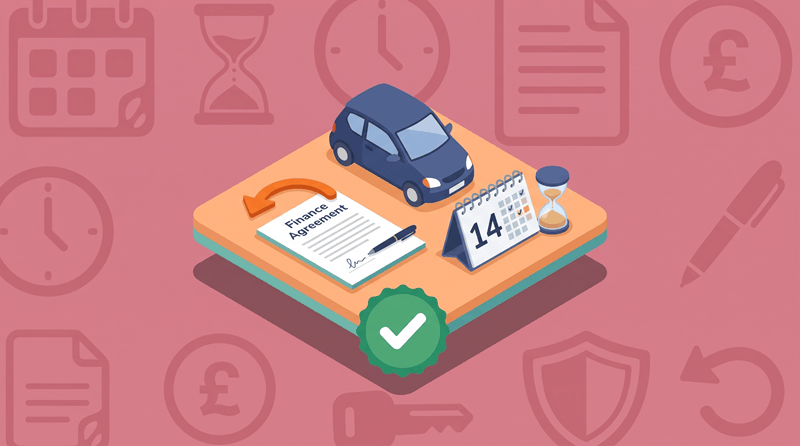
Withdraw within 14 days: you can pull out of the credit agreement without giving a reason, but you'll need to repay what you borrowed plus interest for the days you had it. This doesn't apply if you're borrowing more than £60,260 (section 66A)
Pay it off early: you can settle the agreement at any time (section 94). Ask your lender for a settlement figure first
End the agreement and hand the car back: this is called voluntary termination, and you can do it at any time before the final payment is due. If you've paid less than half of the total amount payable, you'll need to pay the difference up to half, unless your agreement asks for less. You may also have to pay more if you haven't taken reasonable care of the car (sections 99 and 100)
Protection once you've paid a third: if you fall behind after paying at least a third of the total amount payable, your lender needs a court order to take the car back, unless you agree to return it (section 90)
CS finance FAQs
Can I sell a car on CS finance?
Not without your lender's permission, because it owns the car until you've made every payment. Citizens Advice warns that selling it without permission is a criminal offence. The usual route is to pay off the finance first. Read more about selling a car that's still on finance.
Is CS finance the same as a car loan?
No. With a personal loan, you borrow the money, buy the car outright and own it from day one, so you can sell it whenever you like. With CS, the lender owns the car until the end of the agreement. Here's how personal loans compare to car finance.
Does CS finance affect my credit score?
Yes. Applying usually involves a hard credit search, which shows on your credit file, and missed payments can lower your score. Find out more about what affects your credit score.
There are a range of financial products available that may suit your needs. We encourage you to research your options carefully and consider seeking independent financial advice before making any decisions. This blog is for informational purposes only and does not constitute financial advice.