What is debt consolidation?

Written by
Joe Towner
Reviewed by
Amy LancashireDebt consolidation means combining several debts into one, so you make a single monthly payment instead of juggling many. People usually do it to simplify their repayments, or to try to pay less interest. It doesn't reduce the total you owe, and whether it actually saves you money depends on the interest rate and term you get.
This guide explains what debt consolidation is, how it works, the ways to do it in the UK, the trade-offs to weigh up, and the alternatives worth considering first.
What does debt consolidation mean?
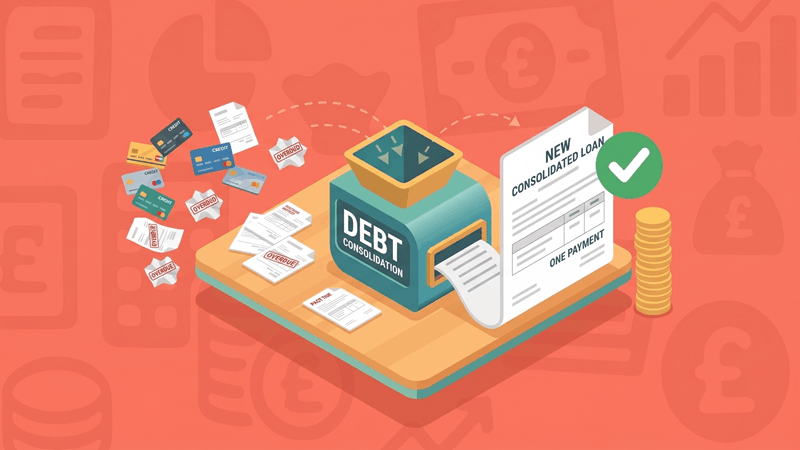
Debt consolidation is the process of rolling multiple debts into one new agreement. Those debts might be credit cards, personal loans or overdrafts, each with its own balance, interest rate and payment date.
When you consolidate, you take out enough new credit to clear all of them, then repay just the one new agreement. The key thing to understand is that consolidating moves your debt into one place. It doesn't clear it. You still owe the money, you're just paying it back in a different way.
How does debt consolidation work?
In practice, it usually follows four steps:
Add up what you owe across your existing debts, along with the interest rate on each one
Take out new credit large enough to cover the total, usually a loan or a balance transfer credit card
Use that money to pay off your existing debts in full
Repay the new agreement in one monthly payment over a fixed term
Here's a simplified illustration. Say you owe £2,000 on one credit card and £3,000 on another, each with a different rate and payment date. You take out a £5,000 loan, use it to clear both cards, and from then on make one monthly payment to a single lender. This is a simplified example and doesn't include any fees or interest.
How do I find out all my debts?
Before you consolidate, it helps to know exactly what you owe. Pulling everything together in one place is the first real step.
Step 1: Check your credit report. In the UK, three credit reference agencies hold your credit history: Experian, Equifax and TransUnion. Your report lists most credit accounts, including credit cards, loans, overdrafts, car finance and some buy now, pay later accounts. You're entitled to a free statutory copy from each agency under data protection law, and all three also offer free online access
Step 2: Check more than one agency. Lenders don't all report to the same agency, so a debt that shows on one report might not appear on another. It's worth checking all three
Step 3: Gather your statements. Recent statements and online banking show your current balances, interest rates and minimum payments, which a credit report won't always spell out
Step 4: Remember what won't show up. Some debts don't appear on a credit report at all, such as money you owe to friends or family. Check letters and emails from anyone you owe
Once you've listed each debt with its balance, interest rate and monthly payment, you should have the full picture, and you can see whether consolidating would actually leave you better off.
Why do people consolidate debt?
In March 2026, people in the UK households borrowed a net £1.9 billion in consumer credit in a single month, with credit card borrowing up 12.3% on the year, according to the Bank of England's Money and Credit statistics. When that borrowing is spread across several cards and loans, it can be harder to keep track.
People might consolidate for reasons such as:
One payment, one date. Tracking several debts can make it easier to miss a payment. A single monthly payment is simpler to manage
Potentially lower interest. If you qualify for a rate lower than what you're paying now, you could reduce the interest you pay overall
A clear end date. A fixed-term loan has a set finish date, unlike credit card minimum payments, which can stretch on for as long as the debt exists
Ways to consolidate debt in the UK
There are three common routes. The right one depends on what you owe, how much, and your credit history.
Debt consolidation loan (unsecured)
This is a personal loan used to pay off your other debts, with nothing secured against it. The rate you're offered depends on your income and credit history. You can read more about how debt consolidation loans work, and the difference between secured and unsecured loans.
Secured or homeowner loan
A secured loan is borrowed against an asset you own, usually your home. It may offer a lower rate or let you borrow a larger amount, but there's a serious trade-off: your home is at risk if you can't keep up the repayments. Here's more on what a secured loan is.
Balance transfer credit card
If your debts are all on credit cards, you can move them onto a single card that potentially has a 0% interest period. You'll usually pay a transfer fee, and the 0% rate is temporary, so it's worth understanding what a balance transfer is before you apply.
What are the pros and cons of debt consolidation?
Debt consolidation can help, but it isn't right for everyone. It's worth considering whether the positives and negatives are right for your situation.
Pros:
One payment to manage instead of several
You could pay less interest, if you qualify for a lower rate than your current debts
A fixed-term loan gives you a clear date when the debt will be cleared
Cons:
It doesn't reduce what you owe
Spreading payments over a longer period can mean paying more in total, even at a lower rate
Applying involves a hard credit search, which can dip your score in the short term
Whether a debt consolidation loan is right for you or not, it’s also important to remember that while it can simplify your debt situation, it doesn’t get rid of it. If you don’t keep up with repayments or take on even more debt, the same problems with managing debt will keep coming back.
How does debt consolidation affect your credit score?
Consolidating can affect your credit in a few ways, some positive and some negative:
Applying leaves a mark. A new credit application triggers a hard search, which can lower your score slightly for a few months.
A new account changes your profile. Opening a new loan or card reduces the average age of your accounts at first
It can improve your credit utilisation. Paying off and closing credit card balances lowers how much of your available credit you're using, which can help. Here's more on credit utilisation.
Repayment history matters most. Making the new payments on time builds a positive record. Missing them does the opposite, and missed payments stay on your credit file for six years
Can you consolidate debt with bad credit?
It may be possible, but it comes with caveats. ‘Bad credit’ is also known as adverse credit, which is a formal term used by lenders, mortgage brokers, and on financial application forms to describe a credit history that contains specific negative markers. Lenders will view adverse credit history as higher risk, so you're more likely to be offered a higher interest rate or turned down altogether. Getting a higher rate can cancel out the main reason for consolidating, because you could end up paying the same or more on your existing debts.
If you're considering consolidating with adverse credit, it's worth taking a few steps first:
Check the rate you'd actually be offered, not just the advertised one. Under FCA rules, a lender only has to offer its advertised representative APR (or a better rate) to 51% of people who take out credit through that promotion, so the rate you're offered could be higher
Use eligibility checkers that run a soft credit check. A soft search lets you compare your chances without impacting your credit score
Treat repeated rejections as a signal. If you're being declined or only offered very high rates, borrowing more may not be the answer, and free debt advice could help more
Alternatives to debt consolidation
Consolidation is one option, not the only one. Depending on your situation, one of these may suit you better:
Budgeting and overpaying. Paying more than the minimum on your highest-rate debt first, while keeping up minimum payments on the rest, can clear debt faster without new borrowing.
A balance transfer. If your debt is only on credit cards, moving it to a 0% card may be enough on its own.
A debt management plan (DMP). An informal arrangement, often set up through a free debt charity, where you repay your debts in full but at a lower monthly amount you can afford. Creditors may agree to freeze interest, though they don't have to. Learn how a DMP can impact your credit score.
An individual voluntary arrangement (IVA). A formal, legally binding agreement to repay what you can afford over a set period. Read more about what an IVA is.
A debt relief order (DRO). Aimed at people with a low income, low debts and few assets.
If you're finding it hard to keep up with essentials or you're already missing payments, taking on more borrowing may not be the answer. Free, impartial advice is available from StepChange and National Debtline. It's also worth reading our guide on how to get out of debt.
Debt consolidation vs a debt management plan
These two get confused often, but they work very differently. Debt consolidation is new borrowing that replaces your existing debts. A debt management plan doesn't involve any new borrowing. Instead, you arrange to repay your existing creditors in full, but at a lower monthly amount, usually through a debt charity.
| Debt consolidation | Debt management plan |
|---|---|---|
What it is | New borrowing to replace your debts | An arrangement to repay your debts in full at a lower monthly amount |
New credit needed? | Yes | No |
Who arranges it | You, with a lender | Often a free debt charity, or a fee-charging firm |
Interest | Depends on the new rate you get | May be frozen if your creditors agree, but it's not guaranteed |
Best suited to | People who can get a lower rate and stay on top of spending | People struggling to meet their current payments |
Which one fits depends on your situation: whether you can realistically get a new loan at a better rate, or whether what you really need is to reduce what you pay each month.
FAQs about debt consolidation
There are a range of financial products available that may suit your needs. We encourage you to research your options carefully and consider seeking independent financial advice before making any decisions. This blog is for informational purposes only and does not constitute financial advice.