Holiday Spending Hacks: The Best Value Destinations for 2026


Written by
Emily TyeAs travellers start planning their holidays for the summer, many are looking for destinations that offer great experiences without the high costs often associated with the world’s most famous hotspots. Barcelona may have been the most-booked destination in 2025, but there are plenty of lesser-known locations that offer equally memorable experiences at a fraction of the price.
With travel costs continuing to vary widely between destinations, understanding where money is most likely to be spent can make a big difference when planning a trip. From flights and accommodation to everyday purchases like meals, shopping and transport, the true cost of a holiday often goes beyond what people may think.
With this in mind, the credit card experts here at Zable have analysed a range of travel factors to understand where travellers can get the best value. The analysis also looks at everyday spending habits abroad, the cost of food and dining, and destinations that offer similar experiences to some of the world’s most famous bucket-list locations.
The best value underrated destinations
To understand which underrated destinations offer the best value for travellers, we analysed a range of travel costs alongside factors that shape the overall holiday experience.
Flight prices were based on the average cost of direct economy return flights from the UK travelling in July, while accommodation prices reflect the average cost of a five-night stay in an entire home or apartment for two people. Local tourist taxes were also included to capture the typical additional costs travellers may face when visiting each destination.
We also considered what each location offers visitors, including the number of highly rated attractions and the cost of visiting the most popular local attraction, as well as looking at how popular each destination is with tourists using international visitor arrival figures.
Environmental and seasonal travel factors were also included, such as average July temperatures, sunshine hours, and noise and light pollution levels. To capture online popularity, we also analysed the number of TikTok and Instagram posts associated with each destination.
Together, these metrics help create an overall “bang for your buck” score, highlighting destinations that offer a strong balance of affordability, experiences and travel appeal for holidaymakers planning trips in 2026.
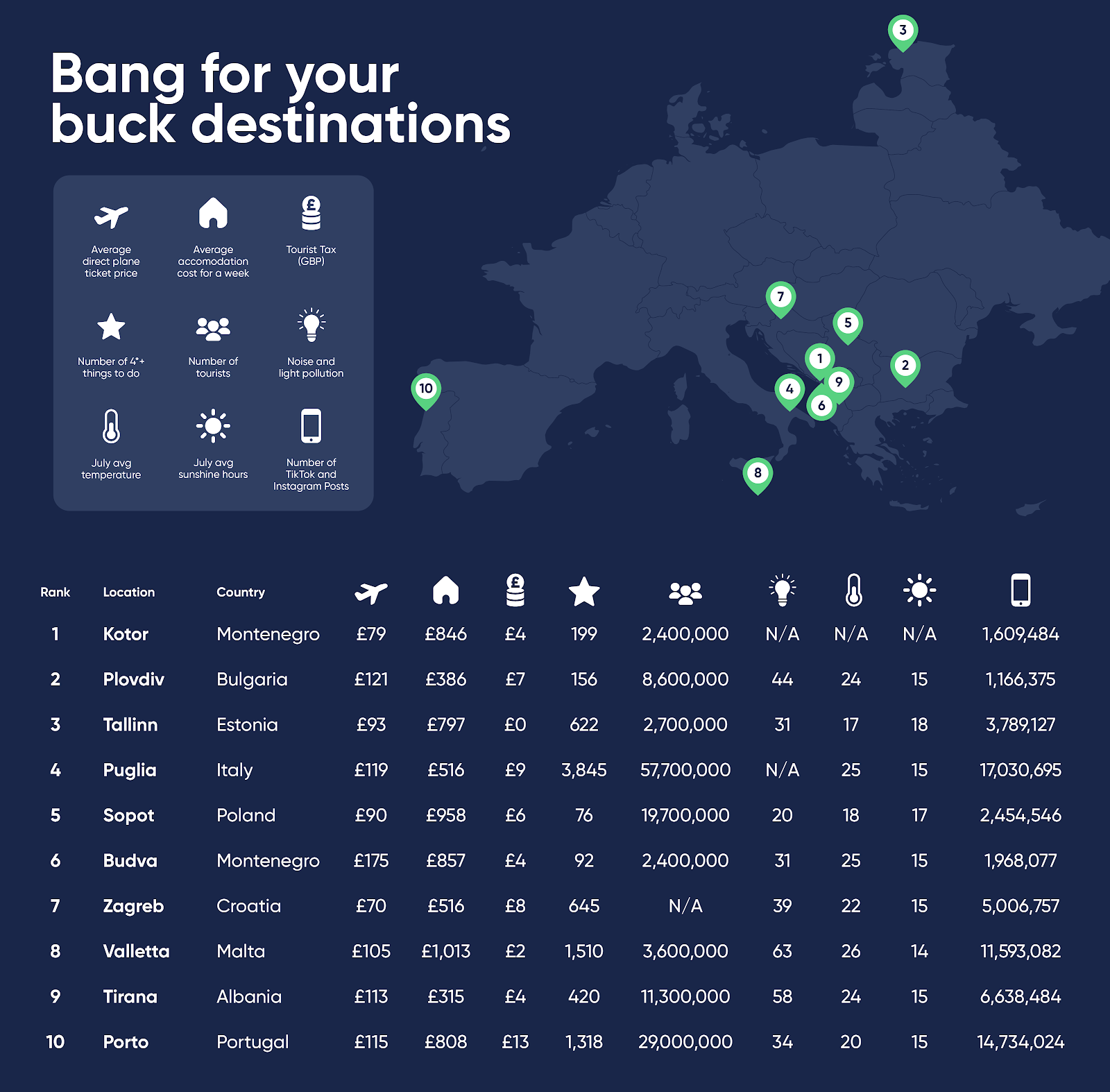
Kotor revealed as the best underrated destination for travellers seeking value
Topping the list of destinations offering the best value is Kotor in Montenegro, which stands out thanks to its relatively low travel costs combined with its impressive range of attractions.
Return flights to Kotor average just £79, while accommodation costs sit at around £846 per week (five nights), making it one of the more affordable destinations on the list. The city also has a relatively low tourist tax of £4 per person for the entire stay, helping to keep overall travel costs down.
Complementing its affordability, Kotor also offers plenty to see and do, with 199 highly rated attractions and around 2.4 million visitors each year. At the heart of the town is Kotor’s UNESCO-listed Old Town, a maze of cobbled streets, medieval squares and centuries-old churches that give visitors a glimpse into the region’s long history.
For travellers hoping to combine historic streets, coastal scenery and outdoor views in one destination, Kotor shows how a smaller Adriatic town can deliver the kind of experience people often associate with much larger Mediterranean destinations.
Plovdiv ranks second thanks to its low accommodation costs
Plovdiv in Bulgaria ranks second overall, offering one of the most affordable accommodation prices of any destination analysed. For travellers looking for a cultural city break packed with history but without the prices of Western European capitals, Plovdiv offers a surprisingly rich experience.
A week’s stay in Plovdiv costs just £386 on average, making it significantly cheaper than many other European city break destinations. Flights are also relatively affordable at £121 on average, while tourist taxes remain modest at £7.
Tallinn offers the highest number of top attractions
Tallinn, Estonia, takes third place, driven largely by its high number of attractions and strong social media presence.
The city boasts 622 four-star attractions, the highest figure among the top three destinations. Its fairy-tale Old Town, medieval architecture and thriving food scene have also helped it gain popularity online, generating more than 3.7 million TikTok and Instagram posts.
Travellers planning to visit several attractions may find the Tallinn Card useful, as it includes free entry to dozens of museums and unlimited public transport across the city.
The most affordable destinations
For many travellers, choosing where to go on holiday often comes down to cost. While some destinations can quickly push up travel budgets, others make it much easier to keep spending under control once you arrive.
Our analysis highlights several destinations where accommodation, attractions and everyday expenses like food and drinks remain relatively affordable, based on the cost of a typical grocery shop and a meal out.
If you’re planning on using a credit card for spending overseas, you might want to check whether your provider charges foreign exchange fees. Credit cards that don’t charge FX fees help holidaymakers avoid additional costs when paying in local currencies.
The top 10 cheapest destinations for a five-night stay:
Rank | Location | Country | Total Cost |
|---|---|---|---|
1 | Tirana | Albania | £492.31 |
2 | Plovdiv | Bulgaria | £558.10 |
3 | Zagreb | Croatia | £651.06 |
4 | Puglia | Italy | £690.37 |
5 | Gran Canaria | Spain | £761.06 |
6 | Seville | Spain | £802.47 |
7 | Fuerteventura | Spain | £844.13 |
8 | Bari | Italy | £914.81 |
9 | Tallinn | Estonia | £953.11 |
10 | Kotor | Montenegro | £974.03 |
Tirana ranks as the cheapest destination overall for a five-night holiday
Our analysis of travel expenses shows that Tirana, Albania, is the cheapest destination overall, with the combined cost of flights, accommodation, tourist taxes, attractions, groceries and dining reaching £492 for a typical five-night trip.
One of the key factors behind Tirana’s affordability is the relatively low cost of accommodation and everyday expenses. Grocery shopping and dining out are among the cheapest of any destination analysed, helping visitors keep daily spending under control once they arrive.
Plovdiv combines low food prices with affordable travel costs
Plovdiv, Bulgaria, ranks as the second-cheapest destination, with a total trip cost of £558. While flights are slightly higher than in some other destinations, this is balanced out by lower food prices and the fact that many of the city’s top attractions can be visited for free.
Zagreb ranks among Europe’s most affordable capital city breaks
Zagreb in Croatia also ranks among the most affordable destinations, with a total cost of £651. Compared with many other European capitals, Zagreb offers relatively moderate accommodation prices alongside a wide range of cultural attractions and green spaces.
Southern European destinations also offer affordable holidays
Travellers do not necessarily need to sacrifice warm climates or well-known destinations to keep their holiday budgets under control. Several southern European destinations also perform well when it comes to overall affordability.
Locations such as Puglia in southern Italy and Gran Canaria in Spain both rank within the ten cheapest destinations analysed. In these locations, moderate accommodation costs combined with relatively affordable food and drink help keep overall trip costs manageable.
Destinations such as Seville and Fuerteventura also offer a balance of warm summer weather, cultural attractions, and relatively affordable travel costs from the UK.
Where travellers spend the most money abroad
While some destinations stand out for their overall affordability, spending patterns abroad show where travellers are most likely to open their wallets once they arrive.
Using internal Zable transaction data from January 2022 to January 2026, we analysed where customers are spending the most money overseas, as well as the types of purchases that make up the largest share of travel spending.
The findings reveal a mix of popular European holiday destinations and long-haul travel hotspots where spending levels are particularly high.
Ireland, Spain and the United States top the list for overseas spending
We analysed where UK customers are spending the most money overseas, and found that 21% of all overseas payments in the period since January 2022 were made in Ireland.
Spain follows as the second-highest destination for overseas spending, with 10.5% of the total overseas spend being made here, reflecting its continued popularity as a holiday destination for UK travellers.
The United States ranks third, with an additional 10% of overseas payments being made here, driven largely by spending in major cities and tourist destinations.
We asked Arielle Rogers-Jenkins, Senior Product Manager (UK Credit Cards), for their advice on how travellers can better manage their holiday spending:
“Planning a holiday often involves balancing the experiences you want with the budget you have available. Our data shows that costs can vary significantly depending on where you travel, so choosing destinations that align with your budget can make a big difference to the overall cost of a trip.
“However, you need to consider more than just getting there, and accommodation costs, as it’s the ad hoc costs, such as eating out and experiences, that can quickly stretch the budget.
“For travellers looking to keep their holiday spending under control, it can be helpful to plan and think about the kinds of experiences you want to enjoy. Choosing destinations where everyday costs are lower, or setting a clear spending budget before travelling, can have a positive impact on your holiday spending.”
The cost of food on holiday
For many travellers, self-catering accommodation offers greater flexibility while on holiday. Having access to a kitchen means travellers can cook some meals themselves, pick up ingredients from local markets or supermarkets, and avoid eating out for every meal.
This can make a noticeable difference to overall travel budgets, particularly for families or groups travelling together. To explore how everyday food costs vary between destinations, we analysed both the price of a typical grocery shop and the average cost of eating out across popular holiday locations.
The top 10 destinations with the cheapest grocery shop total:
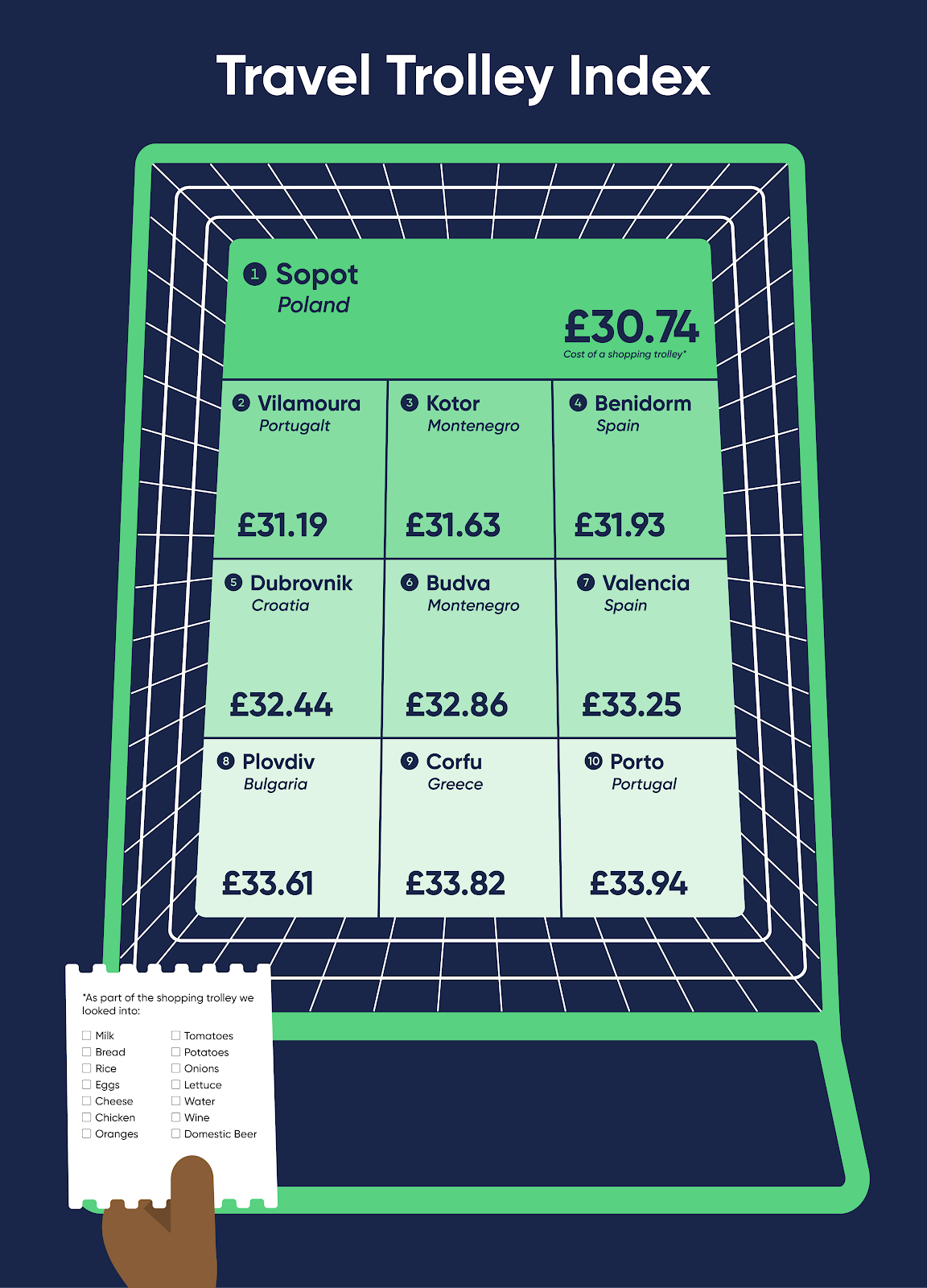
Sopot offers the cheapest grocery shop for self-catering travellers
Sopot in Poland offers the cheapest grocery shop overall, with a typical basket of everyday items costing £30.74. Located on Poland’s Baltic coast, the resort town has grown in popularity in recent years thanks to its beaches, colourful architecture and lively summer atmosphere.
Vilamoura in Portugal also ranks among the cheapest, with a basket costing £31.19, followed closely by Kotor in Montenegro at £31.63.
Other destinations where grocery shopping remains relatively affordable include Benidorm (£31.93) and Dubrovnik (£32.44), suggesting travellers across several popular holiday locations can keep day-to-day food spending relatively manageable.
Plovdiv offers the cheapest meals for travellers eating out
While grocery prices can help travellers keep costs down, eating out remains a key part of many holidays. Sampling local food and drink is often one of the highlights of travelling abroad, but restaurant prices can vary significantly depending on the destination.
The top 10 destinations with the cheapest bill for eating out:
Rank | Location | Country | Total Price |
|---|---|---|---|
1 | Plovdiv | Bulgaria | £9.91 |
2 | Puglia | Italy | £11.76 |
3 | Lanzarote | Spain | £12.55 |
4 | Tirana | Albania | £12.92 |
5 | Kotor | Montenegro | £13.09 |
6 | Corfu | Greece | £13.31 |
7 | Gran Canaria | Spain | £13.43 |
8 | Vilamoura | Portugal | £13.72 |
9 | Faro | Portugal | £13.86 |
10 | Madeira | Portugal | £13.95 |
Our analysis of restaurant prices across the same destinations shows that Plovdiv in Bulgaria offers the cheapest meal out overall, with the average cost of a meal at an inexpensive restaurant, a draft beer and a soft drink totalling £9.91.
Southern European destinations also perform well when it comes to dining affordability. Puglia in Italy ranks second, where the same combination costs £11.76, followed by Lanzarote, one of Spain’s Canary Islands at £12.55.
Other destinations where eating out remains relatively affordable include Tirana (£12.92) and Kotor (£13.09), both of which also ranked highly in the overall value and cheapest destination rankings.
Destination dupes: the cheaper alternatives to bucket-list locations
Some of the world’s most famous destinations sit high on travellers’ bucket lists, but they often come with high prices, long flight times or growing tourist crowds. Because of this, more travellers are beginning to look for “destination dupes”, places that offer similar scenery, climate or experiences, but may be easier to reach or less expensive.
To explore this, we compared destinations based on climate, sunshine levels, tourism appeal and environmental factors. Looking at metrics such as average July temperatures, hours of sunshine, and the number of highly rated attractions helped highlight locations that offer a similar style of holiday experience in Europe.
Capri offers similar summer conditions to the Maldives
Capri shares several characteristics with the Maldives, particularly when it comes to warm summer weather and coastal scenery.
The Maldives sees an average July temperature of 28.5°C, while Capri averages 26.5°C, meaning both destinations offer the kind of warm conditions travellers typically look for in a beach holiday. Capri also receives around 14.7 hours of sunshine per day in July, slightly more than the Maldives’ 12.3 hours, giving visitors long, bright days by the sea.
While the Maldives has a larger tourism offering with 456 highly rated attractions, Capri still features 128 four-star attractions, showing that travellers can find plenty to explore while enjoying a similar island setting.
Crete offers a climate similar to Phuket summer temperatures
We spoke to Susan Horton, Europe Destination Expert at Travelbag, who explains:
"Greece’s largest island, Crete, and Thailand’s largest island, Phuket, have a lot in common. During the UK’s summer, both places enjoy warm weather, with temperatures reaching the high 20s to low 30s.
“While their climates differ, you’ll find plenty of sunny days for outdoor exploring and beachside relaxing. Whether you pick Crete’s Mediterranean skies or Phuket’s tropical beauty, you’re in for a memorable sunny getaway."
Gran Canaria shares similar climate conditions with the Galápagos Islands
While the Galápagos Islands record an average July temperature of 22.5°C, Gran Canaria averages 23.5°C, meaning both destinations offer similar warm but comfortable conditions. Gran Canaria also receives around 13.7 hours of sunshine per day in July, creating ideal weather for outdoor activities.
Although the Galápagos Islands feature 364 highly rated attractions, Gran Canaria still offers 235, showing that travellers can experience similar island landscapes and outdoor scenery without travelling as far.
The bottom line
Our analysis shows that the cost of a holiday can vary a lot depending on where you choose to go. While flights and accommodation often take up the biggest part of the budget, everyday spending once you arrive can make a real difference to the overall cost of a trip.
In some destinations, lower grocery prices, cheaper meals and more affordable activities can help travellers stretch their budgets further. At the same time, our spending data highlights how quickly smaller purchases like dining out, shopping and local transport can add up while travelling.
The destination dupe analysis also shows that travellers don’t always need to visit the most famous locations to enjoy similar scenery or experiences. In many cases, there are alternative destinations that offer a similar feel but are easier to reach or better suited to different budgets.
For people planning their holidays, comparing destinations and thinking about how you plan to spend while you’re away could make a big difference to how far your travel budget goes.
Sources and methodology
Methodology summary:
This study identifies underrated destinations and affordable holiday locations for travellers planning trips in 2026. To do this, we analysed travel costs, tourism appeal, environmental factors and social media popularity across a range of European destinations.
Our analysis combines data on flights, accommodation prices, tourist taxes, attraction costs, food prices and local experiences to create a “bang for your buck” score. We also looked at everyday travel spending and grocery prices to identify destinations where visitors can keep overall costs lower.
Additional analysis examined internal transaction data to understand where travellers are spending the most money abroad, as well as identifying “destination dupes”, locations that offer similar travel experiences to globally recognised bucket-list destinations based on climate, environmental factors and tourism appeal.
Index 1: “Bang for your buck” travel value score
To identify underrated destinations offering the best overall value, we created an index based on travel costs, tourism appeal and environmental factors.
The following metrics were analysed:
Flight prices – Skyscanner - Direct economy return flights from the UK for 1 adult in July. The average of all scraped results was calculated.
Accommodation prices – Booking.com - Entire home and apartments for two people for five nights in July.
The average of all available results was used.
Tourist tax – Desk research identified the tourist tax applicable to each destination. Values were converted into GBP for comparison.
Number of attractions – The number of four-star and above attractions was sourced from TripAdvisor by applying the “4 star & up” filter on attractions within the “Things to do” section.
Cost of the most popular attraction – The top-ranked attraction for each destination was recorded from TripAdvisor listings. Ticket prices were sourced via desk research and converted into GBP where necessary.
Tourist demand – WorldPopulationReview - Annual tourist arrival figures.
Environmental factors – Numbeo - Noise and light pollution scores
Weather conditions – Average July temperature and sunshine hours were sourced from WeatherSpark.
Social media popularity – The number of TikTok and Instagram posts under each destination hashtag were recorded.
All indicators were standardised before being combined into a final value score.
Index 2: Cheapest destinations for holiday costs
To identify the cheapest destinations overall, we calculated the total estimated cost of a typical five-night trip. The following components were included:
• Average plane ticket price • Average accommodation cost for five nights • Tourist tax (five nights) • Cost of the most popular attraction • Cost of a grocery shop • Cost of eating out
Accommodation data assumes a five-night stay, based on Booking.com’s standard weekly booking structure.
Index 3: Travel Trolley Index (self-catering food costs)
To understand the cost of self-catering holidays, we analysed the price of a typical grocery basket using data from Numbeo.
Items included in the basket were:
Milk (1 litre), fresh white bread (500g), white rice (1kg), eggs, local cheese (1kg), chicken fillets (1kg), oranges (1kg), tomatoes (1kg), potatoes (1kg), onions (1kg), lettuce, bottled water (1.5L), mid-range bottle of wine and domestic beer (0.5L).
The combined price of these items was used to calculate the total grocery basket cost for each destination.
Index 4: Eating out costs
Restaurant spending data was sourced from Numbeo and includes:
• Meal at an inexpensive restaurant • Domestic draft beer (0.5L) • Soft drink (Coca-Cola or Pepsi, 0.33L bottle)
These values were combined to estimate the cost of a typical casual dining experience.
Internal data: Where travellers spend the most abroad
Internal Zable credit card transaction data was analysed to understand overseas spending behaviour.
The dataset covers transactions between January 2022 and January 2026.
Please note that individuals may hold multiple payment cards and may distribute their spending across accounts. The data reflects spending observed on Zable credit cards only.
Destination dupes methodology
To identify “destination dupes”, we first compiled a list of globally recognised bucket-list travel destinations using multiple travel publications. Locations appearing across at least two sources were included.
Alternative destinations were then identified using a statistical similarity approach based on six quantitative indicators including climate, tourism appeal and environmental factors.
Because these indicators are measured on different scales, all values were standardised using z-scores before comparison.
Similarity between destinations was measured using Euclidean distance, which calculates the statistical distance between each pair of destinations across all available metrics. The smaller the distance, the more similar the destinations are overall.
Where data was missing for a particular indicator, that metric was excluded from that specific comparison so destinations were not penalised for incomplete data.
For each bucket-list destination, the European location with the smallest statistical distance was identified as the closest “destination dupe”.
Additional notes
Currency conversions were correct as of 03/03/2026.
Where environmental or pollution data was unavailable for a specific destination, the nearest geographically relevant city with available monitoring data was used as a proxy.
Accommodation costs are based on a five-night stay, and tourist tax values reflect the same duration.