Credit card acceptance rates in the UK: how many people are declined?


Written by
Emily Tye
Reviewed by
Amy LancashireAt Zable, you can link your bank account during your application so we can see your full financial picture before we decide whether you're eligible for a credit card.* Some lenders rely on your credit file alone, which can be one reason people are declined.
To understand how common being declined actually is, we analysed the latest data from the Financial Conduct Authority (FCA), the Bank of England and the Office for National Statistics (ONS). Here's what the numbers show.
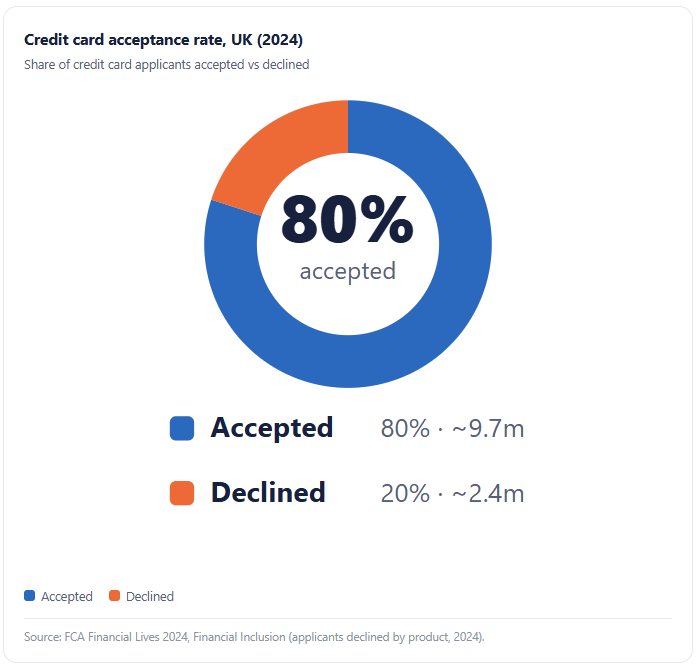
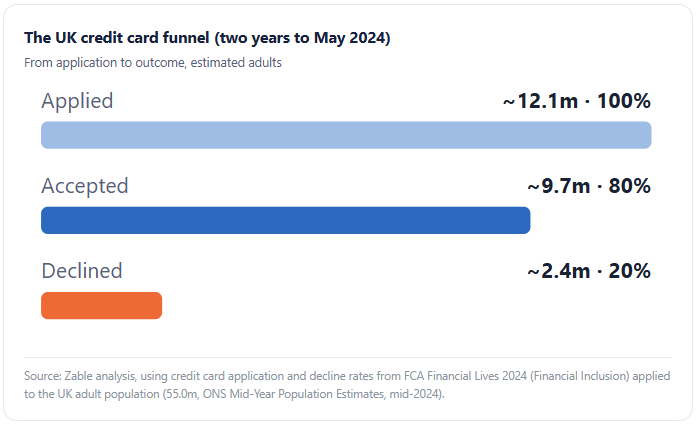
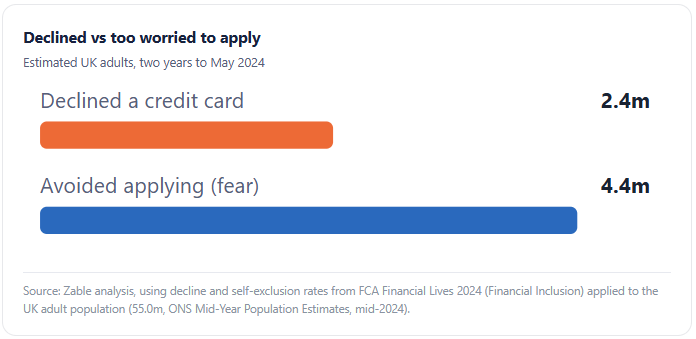
Around 80% of UK credit card applications are accepted, which means roughly 1 in 5 are declined. Across the UK's 55 million adults, that's the equivalent of about 12.1 million people applying for a credit card in the two years to May 2024, and around 2.4 million being turned down.
The more striking number is the one that never shows up in a lender's stats. Around 4.4 million adults didn't apply at all because they expected to be rejected. That's nearly twice the number actually declined.

*Representative 29.9% APR (variable). Subject to eligibility. If you don't qualify, we may offer you a different card with its own terms.
What is the UK credit card acceptance rate?
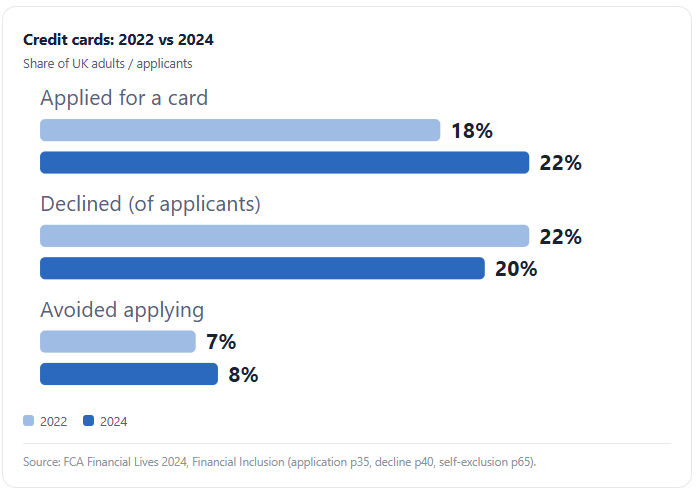
The UK credit card acceptance rate is about 80%. In the FCA's most recent data, 20% of people who applied for a credit card were declined in the two years to May 2024, down from 22% two years earlier. So four in five applicants were accepted, and that figure has edged up slightly.
Acceptance rates aren't published by lenders directly, and they vary by applicant. The 80% figure is an average across everyone who applied, from people with thin credit files to those with long, strong histories.
How many people are declined for a credit card?
About 2.4 million people were declined for a credit card in the two years to May 2024.
That figure isn't published directly. The FCA's Financial Lives 2024 survey reports that 22% of adults applied for a card and 20% of applicants were declined. Applied to the UK adult population, that works out at roughly 12.1 million applicants and around 2.4 million declines.
To put 2.4 million in context, that's about 1 in every 23 UK adults turned down for a single type of credit over two years.
Who is most likely to be declined?
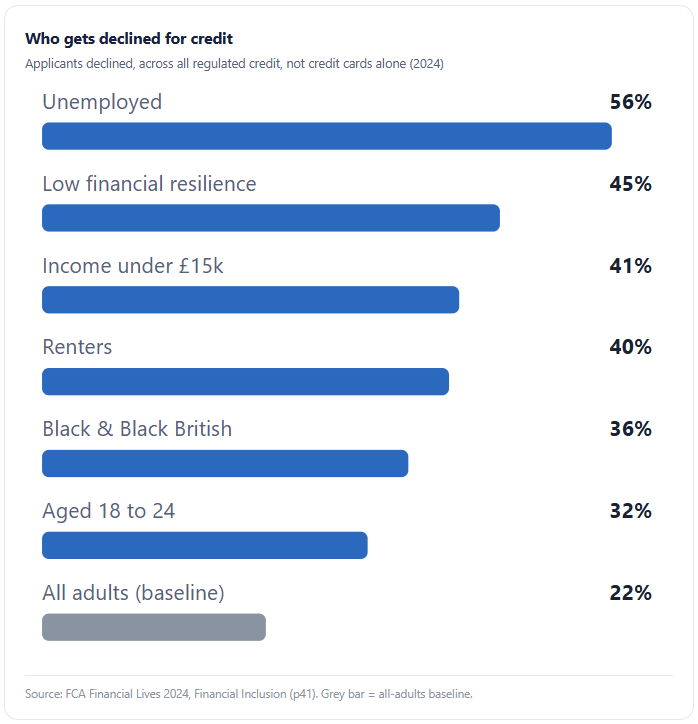
Decline rates aren't spread evenly. The FCA's demographic breakdown covers all regulated credit (credit cards, personal loans, overdrafts, store cards and car finance), not credit cards on their own, so read these as the pattern across borrowing generally rather than card-specific figures. The picture is stark:
Unemployed applicants: 56% declined
Adults with low resilience (less able to withstand a financial or emotional shock): 45%
Household income under £15,000: 41%
Renters: 40%
Black and Black British adults: 36%
Applicants aged 18 to 24: 32% (up 8 percentage points since 2022)
All adults: 22%
The through-line is that the people most likely to need affordable credit are the most likely to be declined it. Younger applicants stand out too. A 32% decline rate for 18 to 24 year olds, rising fast, reflects how hard it can be to be approved when you haven't yet built a track record.
Is a credit card easier to get than other credit?
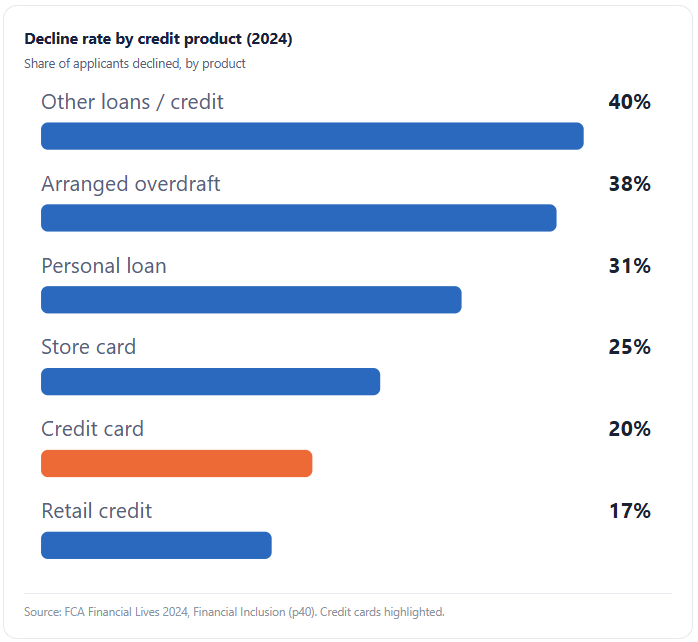
Compared with other forms of borrowing, a credit card is one of the easier regulated credit products to be approved for. Looking at decline rates by product in the two years to May 2024:
Other loans or credit (payday, doorstep and similar): 40% declined
Arranged overdrafts: 38%
Personal loans: 31%
Store cards: 25%
Credit cards: 20%
Retail credit: 17%
A 20% decline rate puts credit cards below personal loans and well below high-cost credit. That partly reflects the range of cards on the market, including products designed for people building or rebuilding their credit.
How many people don't apply because they expect to be declined?
In the two years to May 2024, 8% of UK adults, around 4.4 million people, avoided applying for a credit card because they thought they wouldn't be eligible, couldn't afford it, or would be rejected. That's up from 7% two years earlier.
Put the two numbers side by side and the gap is clear. About 2.4 million people were declined a credit card. Around 4.4 million didn't apply in the first place. Nearly twice as many people rule themselves out as are actually turned down.
Some of that caution is sensible. But some of it is a confidence gap, where people assume rejection without checking. That matters, because you can now check your likelihood of approval with a soft search that doesn't affect your credit score. Understanding what a soft credit check is can remove a lot of the guesswork.

"The data shows two different problems. Some people are being declined, but a far larger group never apply because they assume the answer will be no. Checking your eligibility with a soft search costs you nothing and tells you where you actually stand, without leaving a mark on your credit file."
Head of Growth, Zable
Has credit card acceptance changed since 2022?
Across the FCA's two most recent surveys, the direction of travel is mixed:
Applications rose: 18% of adults applied for a credit card in 2022, rising to 22% in 2024
Acceptance improved: the decline rate fell from 22% to 20%
Self-exclusion crept up: the share avoiding applying rose from 7% to 8%
So more people are applying and slightly more are being accepted, but the number holding back has grown too. Rising applications alongside rising self-exclusion suggests a widening split between people who feel confident about credit and people who don't.
The bigger picture: UK credit card borrowing over time
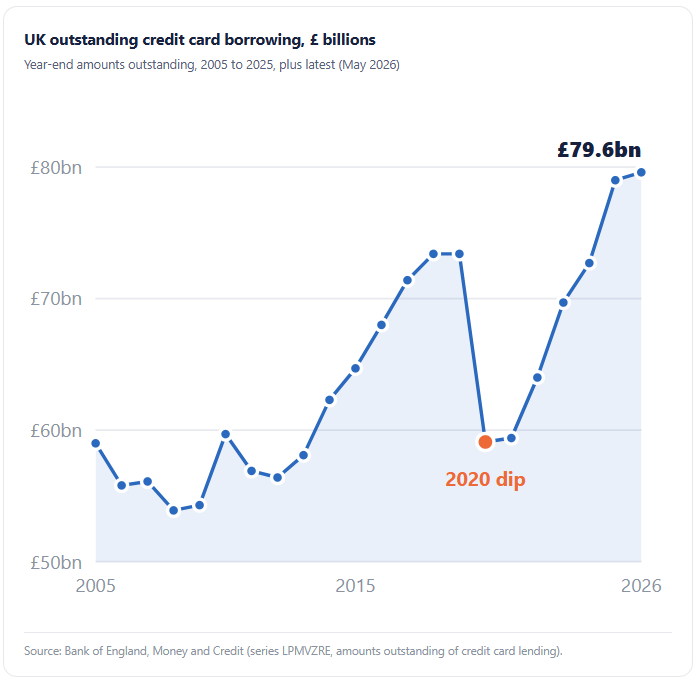
Acceptance is only one side of the market. Outstanding credit card borrowing hit £79.6 billion in May 2026, up 12.1% on the year, according to the Bank of England. The longer arc is telling. Borrowing sat around £73 billion before the pandemic, fell to about £59 billion through 2020 as people paid down balances in lockdown, then climbed to a record high.
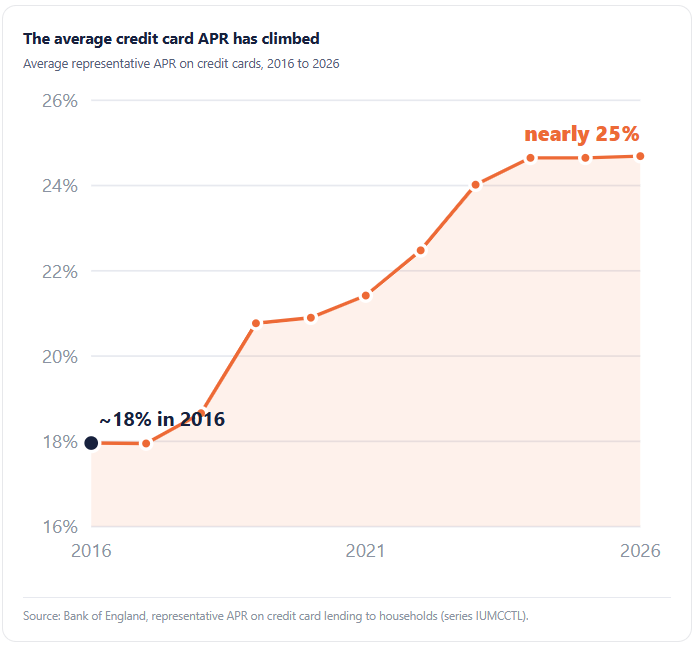
It has also got more expensive. The average representative APR on credit cards has climbed from around 18% a decade ago to nearly 25% today, and has stayed higher even as the Bank of England base rate has eased back from its 2023 peak.
What can I do if I've been declined for a credit card?
Being declined once doesn't lock you out. A few practical steps:
Check your eligibility before you apply again. Eligibility checkers use a soft search that shows your likelihood of approval without leaving a footprint on your credit file. You can check your chances with a soft credit check before making a full application.
Space out applications. Several applications in a short space of time can count against you. It's worth understanding how applying for a credit card affects your credit score before reapplying.
Understand why it happened. Decisions often come down to affordability, credit history or the information on your file. Our guide on why you might be turned down for a credit card covers the common reasons.
Build your profile first. Steps like registering to vote and keeping balances low can help over time. Our guide on how to improve your credit score explains what makes the biggest difference.
Look at cards designed for building or rebuilding credit, such as credit cards for bad credit.
About this data (methodology)
Published:
22% of adults applied for a credit card (18% in 2022); 20% of applicants declined (22% in 2022); 8% avoided applying (7% in 2022). Source: FCA Financial Lives 2024, Financial Inclusion.
UK adult population (18+): 55.0 million, the sum of ONS single-year-of-age estimates for ages 18 and over (ONS Mid-Year Population Estimates, UK, mid-2024, published 26 September 2025). We use 18+ to match the FCA's definition of an adult.
Derived:
Applied ~12.1m (22% of 55.0m adults); accepted ~9.7m (80% of applicants); declined ~2.4m (20% of applicants); self-excluded ~4.4m (8% of adults). Method: FCA percentages applied to the ONS adult population.
Borrowing data:
Bank of England figures, from its interactive database (search the series code to verify), used as market context and not part of the derivation above: outstanding credit card borrowing £79.6bn, May 2026 (series LPMVZRE); annual growth 12.1% (series LPMVVUZ); average representative APR 24.7%, June 2026 (series IUMCCTL); Bank Rate, which peaked at 5.25% in 2023 (series IUMABEDR).
This is a simplified illustration built on survey data, so figures are estimates. Demographic decline rates cover all regulated credit, not credit cards specifically.
This blog is for informational purposes only and does not constitute financial advice. Please speak to a qualified financial adviser before making financial decisions.